


Outdoor Kitchens: Choosing the Perfect Rangehood for Your BBQ Area
There’s a lot to think about when you’re planning an outdoor kitchen. The BBQ usually gets most of the attention – and understandably so – but the things surrounding it can make just as much…

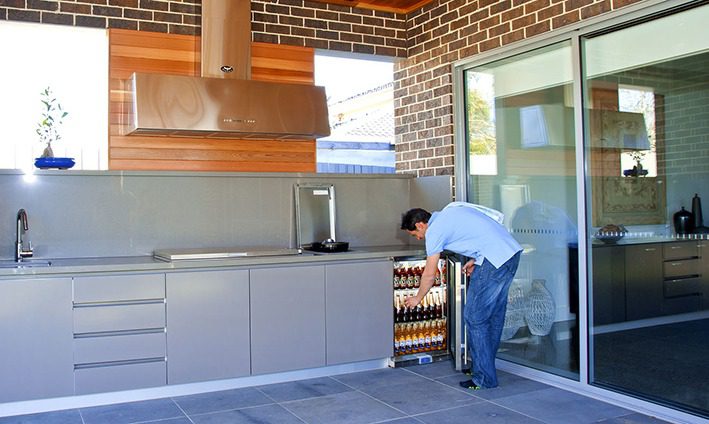
There’s a lot to think about when you’re planning an outdoor kitchen. The BBQ usually gets most of the attention – and understandably so – but the things surrounding it can make just as much difference to how enjoyable the finished space is to use.
One of those things is the rangehood.
If your BBQ sits beneath a covered alfresco area or forms part of a built-in outdoor kitchen, cooking smoke, grease, heat and odours need somewhere to go. Without effective ventilation, they can collect beneath the roof, drift through the entertaining area and leave residue on nearby surfaces.
A properly chosen outdoor BBQ rangehood helps manage all of that while becoming part of the overall design of your kitchen.
But outdoor rangehoods aren’t one-size-fits-all. The size of your BBQ, the kitchen layout, where the rangehood will be mounted, the available ducting and even the finish you prefer can influence the right choice.
Here’s what to consider before you lock one into your outdoor kitchen plans.
Do You Really Need a Rangehood in an Outdoor Kitchen?
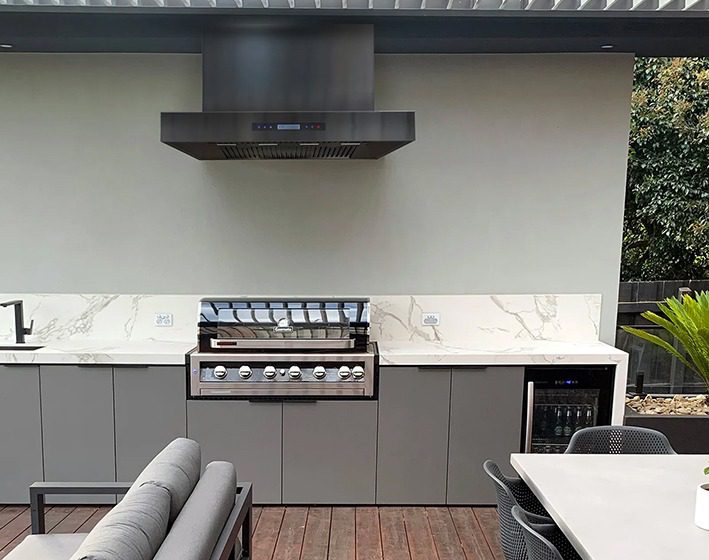
Not every BBQ needs a rangehood.
If you have a freestanding BBQ sitting completely out in the open, with plenty of unrestricted airflow around and above it, a rangehood generally isn’t part of the equation.
A covered or semi-enclosed alfresco kitchen is a different story.
BBQ cooking can produce significant amounts of smoke, grease-laden vapour, heat and cooking odours, particularly when you’re searing meat, cooking fatty foods or feeding a crowd. Beneath a roof, those by-products can accumulate rather than simply dispersing into the open air.
An outdoor rangehood is designed to capture and extract them away from the cooking area.
That can help:
- Reduce smoke around the BBQ and entertaining space
- Remove airborne grease and cooking fumes
- Reduce the amount of residue settling on nearby surfaces
- Make covered outdoor entertaining areas more comfortable
- Provide better illumination over the cooking surface on models with integrated lighting
It’s also important to distinguish between an indoor kitchen rangehood and one designed for an outdoor or alfresco application. Outdoor BBQ cooking places different demands on ventilation, which is why you should choose a rangehood specifically suited to the environment and intended installation.
Outdoor Kitchen Gas Safety and Compliance
Is Your Alfresco Area Considered ‘Outdoor’ for Gas Safety?
If you’re installing a gas BBQ in a covered alfresco area, ventilation isn’t just about keeping smoke and cooking odours under control: it can also be a safety and compliance issue.
WA Government guidance makes it clear that outdoor gas appliances need adequate ventilation and must be installed and used in accordance with the manufacturer’s instructions. An area that feels “outdoor” may not necessarily meet the requirements for an outdoor gas appliance, particularly if blinds, screens or other enclosures restrict airflow.
Importantly, installing a rangehood does not override those requirements or turn an otherwise enclosed space into a compliant outdoor area.
The WA Government’s Outdoor gas appliances in alfresco areas fact sheet includes useful information and diagrams showing examples of compliant and non-compliant outdoor areas, including the amount of permanent, unrestricted opening that may be required.
If you’re unsure whether your alfresco area is suitable for the BBQ you’re planning to install, it’s worth checking the requirements before the outdoor kitchen design is finalised.
What Should You Look for in an Outdoor BBQ Rangehood?
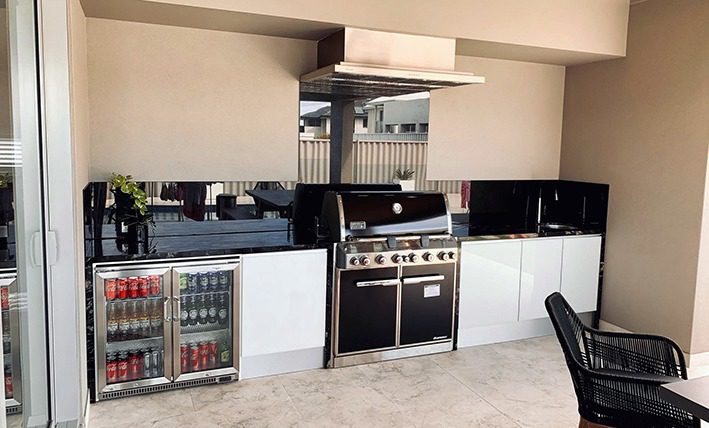
A good outdoor rangehood needs to do more than look impressive hanging above the BBQ.
It needs to work with your cooking equipment, kitchen layout and ventilation arrangement.
These are some of the most important things to consider.
Size and Coverage
Start with the cooking area beneath the rangehood.
The hood needs to provide appropriate coverage for the BBQ it is being paired with. A rangehood that is too small or poorly positioned may struggle to capture smoke and grease effectively, no matter how powerful its motors are.
This is one reason we recommend choosing your BBQ before finalising the cabinetry and rangehood.
Once you know the exact BBQ model, its dimensions and where it will sit, you can select a rangehood that suits the installation rather than trying to make everything fit afterwards.
Always check the installation requirements of both the BBQ and rangehood rather than relying on a generic sizing formula.
Extraction Power
Cooking a couple of eggs on an indoor cooktop and searing six steaks over a hot BBQ are very different jobs.
An outdoor BBQ rangehood needs to cope with the smoke, grease, heat and fumes created by barbecue cooking, so extraction performance is an important part of the decision.
It’s tempting to simply compare the biggest airflow number on the box, but that isn’t the whole story. The size and shape of the hood, ducting arrangement, installation height, motor configuration and BBQ underneath it all contribute to how the finished system performs.
Think of extraction as part of the complete setup rather than a single specification to chase.
Wall-Mounted or Island Installation
Where is your BBQ going to sit?
If your outdoor kitchen runs along a wall, a wall-mounted canopy rangehood is usually the natural arrangement. The rangehood sits above the cooking zone and can become part of the cabinetry and overall kitchen design.
An island kitchen requires a different solution.
If the BBQ sits within a freestanding cooking island away from the wall, a ceiling-mounted model such as the EASIAIR 1200MI Island 316 Stainless Steel BBQ Rangehood can provide ventilation without forcing you to redesign the kitchen around a wall.
This is an important decision to make early, because the rangehood position affects the structure above it as well as the route required for ducting.
Materials Made for Outdoor Conditions
An alfresco kitchen lives in a more demanding environment than the kitchen inside your home.
Humidity, changing temperatures and exposure to outdoor conditions all make material choice important.
Stainless steel is popular for outdoor kitchens because of its durability, easy-clean surface and ability to tie in visually with BBQs, cabinetry and other outdoor appliances.
The Outdoor Chef range includes models manufactured in both 304 and 316 stainless steel, depending on the rangehood. For example, the EASIAIR 1200M and its island counterpart use 316 stainless steel, while other models use outdoor-suitable 304 stainless steel.
The right material can depend on the installation and surrounding environment, so it’s worth discussing where the rangehood will actually be installed rather than choosing purely on appearance.
Style and Finish
Outdoor kitchens have come a long way from a BBQ parked beside a folding table.
They’re now often designed as an extension of the home, with coordinated cabinetry, benchtops, appliances, lighting and entertaining areas.
That makes the appearance of a rangehood relevant too.
Stainless steel remains an easy match for many outdoor kitchens and BBQs. The Euro 120cm Alfresco Canopy Rangehood in Stainless Steel, for example, provides a clean commercial-style look.
For darker cabinetry and more contemporary outdoor spaces, black can create a completely different effect. Options such as the Euro 120cm Alfresco Canopy Rangehood in Black and the Excelsior black rangehoods allow the ventilation to become part of that design rather than standing out against it.
Function comes first – but when you’re building an outdoor kitchen you’ll enjoy for years, there’s nothing wrong with wanting it to look good as well.
How Wide Should an Outdoor BBQ Rangehood Be?
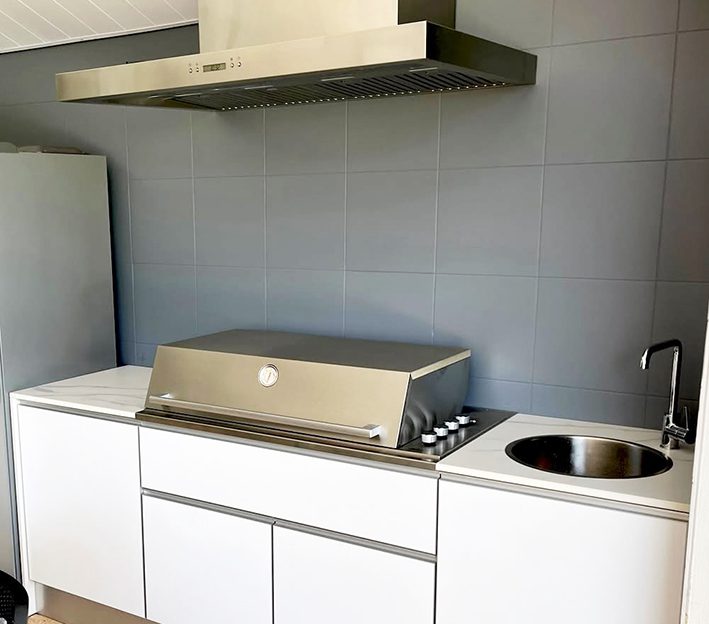
There isn’t one rangehood width that suits every BBQ.
The right size depends on the BBQ beneath it, the design and specifications of the rangehood, its installation height and the overall kitchen configuration.
The Outdoor Chef carries outdoor rangehoods around the 1200 mm mark as well as larger options such as the 1480 mm Excelsior Black Wall-Mounted BBQ Rangehood.
However, bigger isn’t automatically better.
What matters is matching the rangehood correctly to the cooking appliance and installing it according to the relevant manufacturer requirements.
Before cabinetry or overhead structures are finalised, confirm:
- The exact width and depth of your BBQ
- The recommended rangehood for that cooking area
- Required clearance above the cooking surface
- The overall depth of the rangehood
- Where the ducting needs to run
- Any structural requirements for mounting it
Getting those details right on paper is much easier than trying to change cabinetry, ceilings or flues once the outdoor kitchen is already built.
Wall-Mounted or Island Rangehood: Which Is Right for Your Outdoor Kitchen?
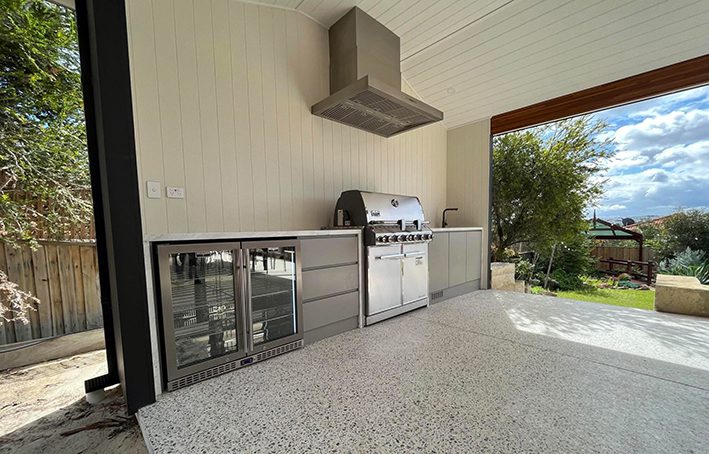
This decision is usually dictated by the layout.
If your BBQ backs onto a wall, you’ll typically be looking at a wall-mounted outdoor canopy. Options within The Outdoor Chef range include the BeefEater 1220 mm Stainless Steel Outdoor Canopy Rangehood, Euro Alfresco models, EASIAIR wall-mounted models and the Excelsior range.
This type of layout works particularly well when your BBQ, sink, fridge and cabinetry are arranged together along one side of the alfresco area.
An island arrangement creates a different style of outdoor kitchen.
Positioning the BBQ in an island allows the cook to face into the entertaining space rather than towards a wall, which can make outdoor cooking feel more social. But it also means you need to plan ventilation above an open cooking zone.
That’s where a purpose-designed island rangehood such as the EASIAIR 1200MI comes into its own.
Neither layout is inherently better. The right option is the one that makes sense for the way you want to cook, entertain and move through the space.
Should You Choose the BBQ or Rangehood First?
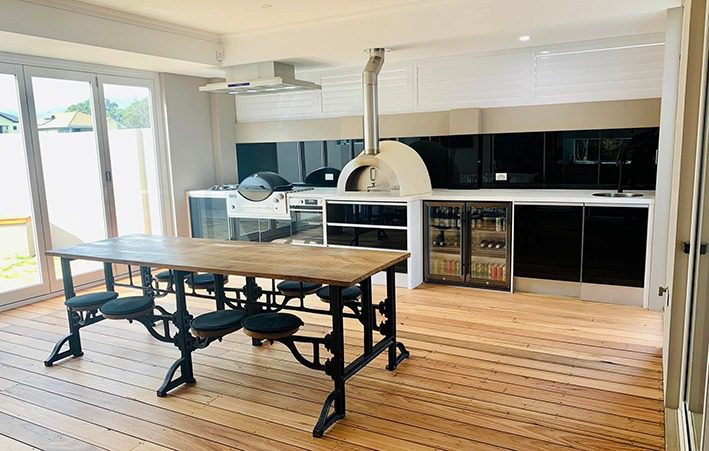
In most cases, choose the BBQ first.
Your cooking appliance determines the cooking area the rangehood needs to service, so it makes sense to know exactly what will be sitting underneath it before you finalise the ventilation.
It also gives you the opportunity to think more broadly about how you actually like to cook.
Someone designing their kitchen around a built-in gas BBQ may need a very different layout from someone who wants room for charcoal cooking, a ceramic cooker or several different appliances.
If you’re still at that stage, exploring the differences between some of the best BBQ brands for outdoor cooking can help narrow down what belongs at the heart of the kitchen before you start designing around it.
And if a Weber is on your shortlist, it’s worth considering the way different models fit into the bigger picture. Our Weber BBQ guide looks at the range in more detail and can help you match the BBQ to your preferred style of cooking.
Once the BBQ decision is made, you can work out the appropriate rangehood, clearances, bench space and cabinetry around it.
Don’t Plan Your Rangehood in Isolation
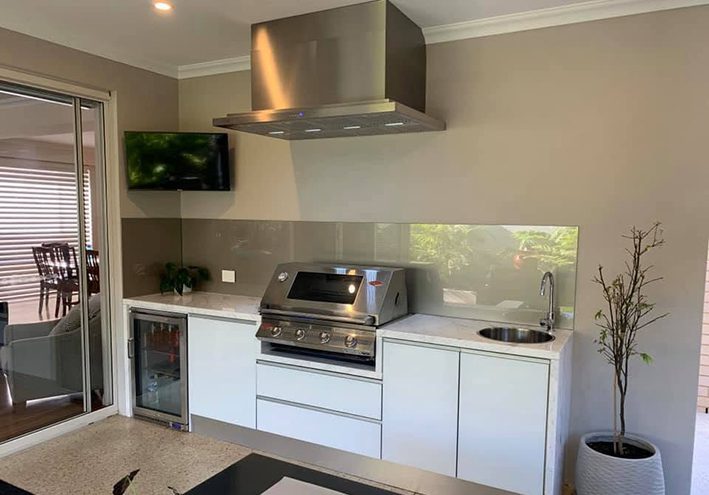
A well-designed outdoor kitchen should feel easy to use.
You shouldn’t need to walk backwards and forwards across the alfresco area looking for ingredients, put a hot tray somewhere inconvenient because there’s no bench space, or disappear inside every time someone wants another drink.
Think about the kitchen as a complete working area.
Where will you prepare food before it reaches the BBQ? Where will you put cooked food afterwards? Where are your utensils stored? Can you reach the fridge without walking through someone else’s space?
Adding refrigeration close to the cooking and entertaining area can make a huge difference. If that’s part of the plan, there are a few outdoor-specific considerations worth understanding when choosing an outdoor bar fridge rather than simply installing any fridge that happens to fit the opening.
Storage matters too.
Tongs, thermometers, gloves, cleaning gear, grill brushes and other BBQ accessories and essential barbecue tools all need somewhere practical to live if you want the finished kitchen to remain uncluttered.
When the BBQ, rangehood, refrigeration, preparation space and storage are planned together, the result feels less like a collection of appliances and more like a proper outdoor kitchen.
Which Outdoor Rangehoods Should You Consider?
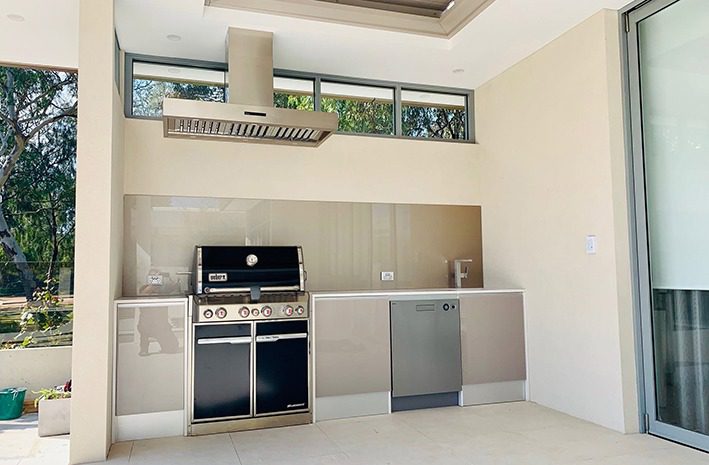
There isn’t a single “best” outdoor rangehood for every alfresco kitchen. A better way to narrow the choice is to start with the layout and look you want.
For a Classic Stainless Steel Outdoor Kitchen
Stainless steel works naturally alongside most BBQs and continues to be one of the most versatile choices for an outdoor kitchen.
The BeefEater 1220 mm Stainless Steel Outdoor Canopy Rangehood is a wall-mounted outdoor canopy featuring twin motors, stainless steel baffle filters and multiple fan settings.
The Euro 120cm Alfresco Canopy Rangehood in Stainless Steel offers another 1200 mm option, while the EASIAIR 1200M 316 Stainless Steel BBQ Rangehood is a wall-mounted model manufactured from 316 stainless steel.
Which one suits you will depend on the BBQ, installation requirements and overall kitchen design rather than appearance alone.
For a Contemporary Black Outdoor Kitchen
Black outdoor cabinetry and appliances can create a striking, modern entertaining area, and there are rangehood options to match.
The Euro 120cm Alfresco Canopy Rangehood in Black gives you a 1200 mm canopy in a black finish.
For another black wall-mounted option, the Excelsior 1200 mm BBQ Rangehood is designed for BBQ applications up to the widths specified by the manufacturer.
Larger cooking areas can also be catered for with the Excelsior 1480 mm Black BBQ Rangehood.
These models are particularly worth considering when you want the rangehood to coordinate with darker cabinetry rather than defaulting to stainless steel.
For an Island BBQ Layout
If the BBQ isn’t against a wall, look at the rangehood from the other direction: where can it be supported from above?
The EASIAIR 1200MI Island 316 Stainless Steel BBQ Rangehood is ceiling mounted and designed specifically for an island-style configuration.
That gives you greater freedom to position the cooking area as the centrepiece of the outdoor kitchen while still planning effective extraction above it.
What Should You Decide Before Buying an Outdoor Rangehood?
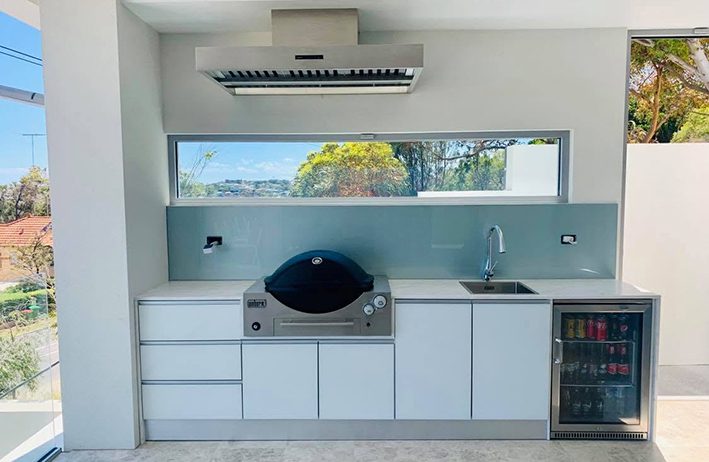
Before ordering the rangehood – and definitely before the cabinetry and ceiling work are locked in – get the important details sorted.
You should know:
- The exact BBQ model and dimensions
- Whether the BBQ will be against a wall or on an island
- The rangehood width and depth required for the installation
- The required distance between the cooking surface and rangehood
- How and where the rangehood will be mounted
- Where the ducting can run
- Whether ducting will travel through a wall or roof
- The finish you want for the overall kitchen
- How the rangehood fits alongside cabinetry and other appliances
And importantly, read the installation documentation for the particular BBQ and rangehood you’re considering.
Different products have different clearance, ventilation, mounting and ducting requirements. Treating those requirements as part of the design from the beginning can save plenty of headaches later.
If you’re working with a cabinetmaker, builder or electrician, having the exact appliance specifications available early also makes everyone’s job easier.
Can The Outdoor Chef Help Plan Your Outdoor Kitchen?
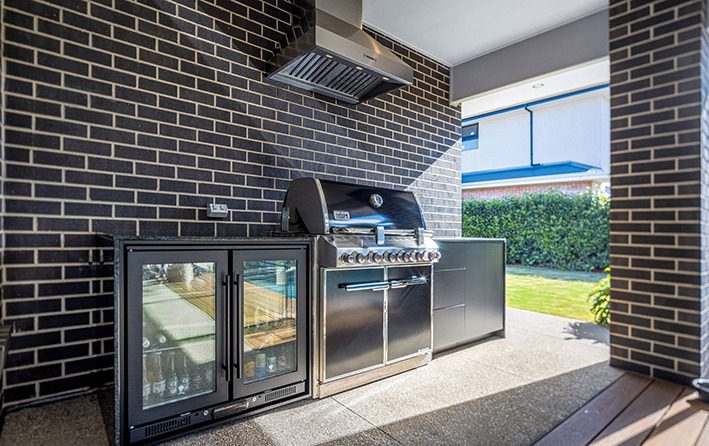
Absolutely.
Choosing a rangehood is easier when it’s considered alongside everything else that makes an outdoor kitchen work.
At The Outdoor Chef, we don’t just look at the appliance sitting on the shelf. We can help you consider the BBQ you want to cook on, the rangehood that needs to sit above it, your refrigeration, storage, cabinetry and the way you want the finished outdoor area to function.
Whether you’re starting with a blank alfresco space or upgrading an existing BBQ area, getting those decisions right before installation can make a huge difference to the finished result.
Explore our range of outdoor rangehoods online, or visit The Outdoor Chef in Osborne Park or Joondalup and talk to our team about your plans.
Bring along your measurements, BBQ ideas and a rough sketch of the space if you have one. We’ll help you work through the options and create an outdoor cooking area that doesn’t just look the part – it works properly every time you fire up the BBQ.
More from Guides
View all Guides
Which Weber BBQ Is Right for You?
After years of helping customers choose barbecues, we’ve learned that the most common mistake people make isn’t about features or price, it’s buying the wrong barbecue size for...
Read more
Weber Q Series Grill Guide: Which Weber Q Is Best for Perth Homes?
Many people ask which Weber Q series grill is best because the range offers simple cooking, strong heat, and easy cleaning. Perth homeowners enjoy outdoor cooking all year,...
Read more
Best BBQs in Perth WA: How to Choose the Right Grill for Your Outdoor Lifestyle
Outdoor entertaining has become a major part of modern Australian living, especially in Western Australia where warm weather makes alfresco dining enjoyable throughout the year. Investing in one...
Read more